Showing posts with label Sixth CPC. Show all posts

Wednesday, 17 June 2009

Some hazards of blogging

Writing a blog appeared to be a simple and harmless activity when I decided to take a plunge about a year back. My son who has some encouraging views on my writing skills goaded  me to continue writing with some regularity so that I could give vent to emotions which sometimes build up on incosequential issues. This exercise I expected would also build up a network of like minded persons and give us a platform for experience sharing .


My wife has been writing a blog for a longer period (in Hindi) and has cultivated a circle of friends over various cities. Her circle includes people of various age groups who share  an enthusiasm for narrating day to day experiences in simple language. I found some narrations of such bloggers , specially those relating to an old friend or a departed family member quite moving . Off course the number of such  blog writers is  less as compared to number of writers merely trying to impress with sentimental and emotional outbursts still they are a close community who share joys and sorrows and sometimes also meet each other while visiting another town where a known blogger resides.


My experience was however quite different on this wordpress blog .While I had started this as a  hobby for writing on any topic of immeadiate relevance to me , the report of Sixth Central Pay Commission became available on CPC website. Every week I used to go through one or two chapters and prepare short notes just for personal record and information .I started posting these short notes on my blog also along with other writings. Since at that time everyone around was also calculating  benefits expected out of CPC recommendations therefore I also made some calculations on Excel sheet and later worked out through the same sheet the benefits expected for others.


As the feverpitch for Sixth CPC report built up this blog also started receiving large number of hits, peaking to eight thousand hits on a day in August 2008. (So far this blog has generated  more than 1.78 Lakh hits). But thereafter a new class of readers completely overtook this blog asking for individual information on pay and pension related matters. I tried to periodically explain to readers that I did not have any intention of running a helpline service .This was also beyond my capabilities and being a working person I had no time for any further resarch on service matters. Moreover I also wanted someone to read and appreciate my so called literary pieces on other matters. In fact in my view popularity of pay commission related writings was  expected to be a temporary phenomenon. However things failed to change , the stream of queries continued . I found that more than 95%  readers came via CPC related writings only. In my frustration over lack of interest in my creative pieces I almost gave up this blog with the hope that my abondenment would discourage the visitors for pay related readings and queries.


After a few months I opened this blogsite and saw some disturbing trends. Some of the readers were quarelling between themeselves over profession related matters in less than acceptable fashion. Some comments were not in good taste.I realised that even blogging needs some policing. If things are left to indisciplined readers the consequences can be disastorous. I have put some regulatory mechanism in place now to restict comments and would be monitoring regularly.My apologies to readers who had a free run in recent months and to those who were at the receiving end . I would also continue to take this blog out of the CPC mania and try to  develop it on originally conceived lines. Let us see how far this  endeavour  succeeds.

Thursday, 4 September 2008

Sixth CPC Benefits:That sinking feeling

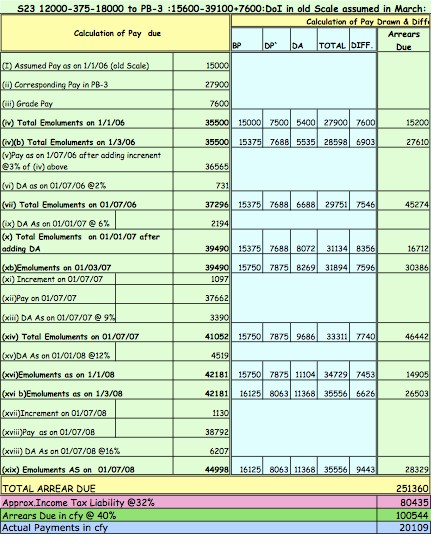
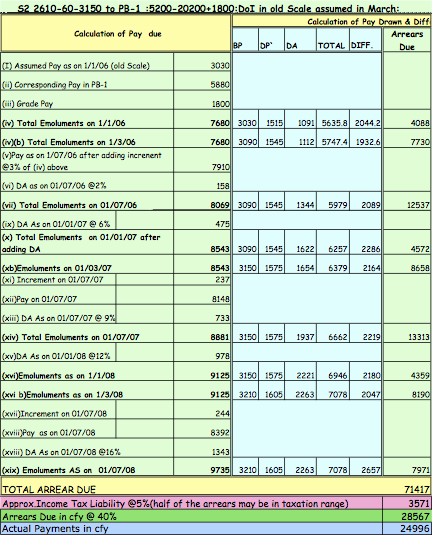
    Since the first round of calculations after notification of Govt. decisions is over, there     is a sinking feeling amongst many of the employees. The Pay Commission benefits      which   appeared to be too good to be true to some at one stage, now seem to be           gradually slipping away after realization of the Income Tax liabilities. Since the tax on   the   entire amount of arrears is to be paid in this financial year and there is no precise commitment about the date by which the balance of arrears would be paid, the picture is a bit despondent. Here are some sample calculations to find out as to how much would be left out to employees. (These are just random sample calculations  which were attempted for sake of having a clear picture . Please do not make requests for advice on individual cases). Since all circulars are available on the net (and some calculators have also been hosted on individual blogs) making individual calculations is not difficult. There is possibility of calculation errors also.If any mistakes are noted,suggestions would be welcome. Income Tax calculations would differ for each case .What is shown here is only approximation.


Monday, 1 September 2008

Sixth CPC Report(xvi):Announcement Regarding Allowances

The Ministry Of Finance has on 29th August 2008 notified the rates of DA and other allowances which are admissible to Central Govt. Employees on basis of recommendations of the Sixth CPC. The details are available on the Ministry website. The revised rates for pension are also available on the same website along with the resolution containing Govt's approvals relating to benefits for the pensioners.

Saturday, 30 August 2008

Sixth CPC:What is the latest

The decisions of the Govt. Of India on recommendations of the Sixth Central Pay Commission (CPC) were notified on 29th August 2008 by the Department of Expenditure , Ministry Of Finance.


The recommendations which are modified include changes in Pay Bands PB-1 (now pushed higher at Rs.5200-20200), PB-2 (now increased to  Rs. 9300-34800) and PB-4 (now starting  lower at Rs.37400-67000)


Grade pay has been increased in several cases over the recommendations oF VIth CPC, the increase  ranges from Rs.500/- to Rs.1000/-,


A new grade is carved out of PB-4 which is to be designated as HAG (Rs.75500-80000/-).


Govt. have approved a multiplication factor of 1.86 (to be rounded off to next multiple of 10) for calculation of corresponding stage in the new scales and rate of annual increment is increased to 3% (4% for achievers) of the sum total of basic pay and Grade Pay.


The Group B Services OF Delhi & Andaman Nicobar Islands Civil & Police Services as well as the cadre of Section Officers in the Central Secretariat Service and Department of Posts shall be placed in PB-2 at induction stage and shall move to PB-3 after 4 years of regular service in Grade Pay of Rs. 5400/- on non functional basis. Somewhat similar benefits have been approved for IAAD officers in whose case all posts of Section Officers , Asstt Accounts/Audit Officers  are to be merged into one .


The Gr, B Officers in Railways and the Audit/Accounts Officers in IAAD are to get grade pay of Rs.5400/-in PB-3 instead of PB-2 as recommended by the Commission.


Scientists in Space, Atomic Energy and Defence Research & Development Organisations have been given various benefits ranging from Rs.1000/- to 2000/- for recognition of good performance. 


The Govt's approval for revised pay-scales is to be implemented w.e.f 1st Jan. 2006. However the arrears for various allowances such as Transport Allowance,HRA shall be payable at the revised rates  from 1st Sept.08 only   . As announced earlier 40% of the arrears are payable in Fy 2008-09 and rest 60% in subsequent year.


For the Purpose of Calculation  Of Dearness Allowance the All India Consumer Price Index 2001 is to be adopted This index presently stands somewhere around 140 and was around 116 in 2006. (The approximate rate of DA payable was found on a Govt Officials' blog.)


Other major decisions concerning administrative reforms relate to approval Of Assured Career Progression Scheme (ACP) with provision for promotion after 10,20 and 30 years and setting up of Anomalies Committees to take care of grievance regarding unfair treatment  Cadre review and empanelment of Gr.A Services is to be updated in one year.


The CPMF Officers of the rank of Commandant and below are to be considered for payment of allowances comparable to Army while deployed in terrorism infested/difficult  areas. However the officers would be losing some personal privilege since the posts of personal attendants known as Suraksh Sahayak are to be abolished . The posts of Addl.DIG upgraded to DIG level  in CPMF shall continue to be manned by their Officers.


The Ministry of Finance has subsequently brought out Revised CCS Pay Rules  2008 for Central Govt. Employees which were followed with instructions Dt. 30th August 2008 which provide the tables for calculation of matching pay and Grade Pay and the methodology for calculation and payment of arrears. This we shall take up in subsequent posts.


Later.....Please see the latest post on this site for exact rates for DA and other allowances


Friday, 15 August 2008

So, finally the suspense over the Sixth CPC report is over!

SINGH seems to have again proved that he is the KING. After winning the confidence vote in the Parliament and having firmed up his grip on the Government PM Manmohan Singh managed to steer the Sixth Pay Commission Report through the Cabinet seemingly with  benefits for everyone. While detailed report on the final decisions is yet to trickle down, the first reports indicate that the matter was tackled in a humanitarian spirit and some harsh suggestions from FM Chidabaram were overruled (including the suggestion for locking up 60% of the arrears in the GPF till retirement).


At this hour when Central Para Military Forces are engaged in tough operations at more than one place in the country and the hardships involved are reportedly taking a heavy toll on the morale of the security forces , the decision to give benefits to Jawans over and above the recommendations of the Central Pay Commission (CPC) and a handsome Military Service Pay to officers was the most sensible  decision to be  taken by the Govt while considering the report.


Increase in annual increment rate to 3% (against 2.5% recommended by the CPC ) and a higher fitment benefit  is another decision which will take the sting out of one major criticism of the report and  shall be giving a reason for cheer to everyone.


The reshuffling of various categories of employees to Pay Bands higher than the ones recommended by the CPC would also take care of the wide ranging dissatisfaction in middle level officers who had complained about the benefits for top level functionaries being much higher than those of others. Special mention needs to be made about opening of the PB-4 for middle level officers- a move which shall ensure that PB-4 shall not be an exclusive domain for top civil servants .


One decision which may appear retrograde to progressive minded mangement experts however stands out. That decision is to discard the recommendation of the CPC for ending further  recruitments for the Gr.D category staff and upgrading the peons and khallasis to semi skilled Gr. C staff. The Govt. could not agree on that and so the humble relics of medieval ages shall hang around for a decade or so, till some Govt. understands the need for dispensing with this organ of governance.


For the Forest and Police Services there are a few benefits in addition to what the CPC had sought to give , such as the creation of Posts of Principal Chief Conservator of Forests and Director General Of Police for every State. But these have apparently not gone down too well and some officers gave vent to their frustration in media over the unfair deal which successive pay commissions have meted out to them.


The Indian Media as usual wants to paint the Pay Commission benefits  as monstrous assault on national economy.On the other hand there was a tough looking guy on the TV who used this opportunity for being projected in national media, for IAS bashing saying that all officers are unworthy of the service !


Sunday, 6 July 2008

Sixth CPC Report:(xv) Recommendations Central Paramilitary Forces

The  recommendations concerning Central Paramilitary Forces (CPMFs) are covered under Ministry of Home Affairs  in Chapter 7.19 of the Sixth CPC report .The CPMFs comprise of the following 7 outfits.


Assam Rifles which originated as Cachar Levy in 1835 is presently having more than 63000 personnel (46 Battalion) .The force working under operational Control of Army guards Indo Myanamar border .


The Border Security Force (157 battalions) has been deployed on international borders since 1965 and also in anti insurgency operations.


The Central Industrial Security Force (CISF)  created in 1969 has more than 1 Lakh personnel deployed for guarding Airports (54), PSU Establishments (269) and several Govt. Buildings (49) including North Block , Part of South Block and CGO complex. It also provides technical consultancy for security and related matters.


Central Reserve Police Force (CRPF) (201 Battalions) having replaced Crown Representative Police of pre independence era is the oldest CPMF. The personnel from this force are engaged in major anti insurgency/ terrorism / militancy related operations in the country.


Indo Tibetan Border Police (ITBP) assists in Disaster Management related work in Central & Western Himalayan Regions and also in providing security cover for Kailash Mansarovar Yatra.


National Security Guard (NSG)  tackles high risk security operations.The personnel are drawn from Army (as Special Action Group) and CPMFs (as Special Rangers Group). The NSG commandos provide security cover for VIPs and take charge of security on special occasions.  


Sashastra Sena Bal which started as Special Services Bureau (SSB) in 1963 is deployed along Indo Nepal & Bhutan border covering stretch of more than 1900 kms in 20 Districts.


The major demand from CPMFs for being given status of organized Group A Services has not been agreed to on the ground that these services do not fulfill the pre requisites for such declaration as fixed by MHA. In support of it’s recommendations  the Commission has pointed out that substantial number of posts in these forces including those in pay scale of 18400-22400 are filled up by drawing officers on deputation from IPS and also pointed out that many intermediate grades do not exist in the hierarchy of these organizations. The Sixth CPC has also reiterated it’s philosophy of avoiding creation of too many services.


Commission has also not agreed to creation of certain additional posts demanded by CPMFs for creating promotional avenues on the ground that there should also be functional justification for posts . It has  felt that the provision of ACPs and the system of Running Pay Bands would minimize the grievances of such nature.


On the positive side the Commission has recommended the merger of the post of Addl DIG with that of DIG (16400-200000) . It has recommend that all posts upto the rank of DIG and 50% posts in the grade of IG and equivalent should be filled by promotion from officers of CPMF.


The following pay structure has been recommended for non gazetted executive cadres of CPMFs.


Commission has also noted that except for CISF all CPMFs are not filling up posts of ASI in the executive cadre .This step being contrary to order Dt.10/10/97 is affecting the structural parity within the forces . It has suggested that all CPMFs should continue the post of ASI since this is a functional necessity.


Other recommendations made by the Commission  include payment of ration money at par with Armed Forces to existing beneficiaries and doubling of the rates for Detachment Allowance (without linkage to DA) . Rates of Kit Maintenance Allowance are proposed to be doubled with increase of 25% after every hike up to 50% in DA. The rates of Uniform Grant are recommended as Rs.13000/-(initial) and Rs.6000/- (renewal-every 3 yrs).


For taking care of housing needs, facility of Compensation in lieu of Quarters (CILQ) has been recommended for all personnel in SO grade also. Commission has also recommended a new Family Accommodation Allowance at the lowest rate of HRA payable to all CPMF personnel who do not qualify for benefit HRA or CILQ or rent free accommodation for reason of their stay in barracks. This will also be a DA linked Allowance.


Commission has rejected the demand of one month’s extra pay for CPMFs having benefit of 60 days earned leave in a year on the ground that the personnel  are already compensated by this 30 days extra leave.


Another major change suggested is for stopping further recruitments to the cadre of followers and absorbing the existing cadres to -1S pay band with the objective of converting them to Gr.C combatant staff  after suitable training. It has been suggested that all non essential jobs handled by followers should be outsourced.


Recommendations also suggest that the practice of attaching Constables (Suraksha Sahayaks) / combatants at the residence of Officers for attending to Telephone calls  or other such personal responsibilities should be stopped. If any cases of violations of these instructions are found, the salary of constables deployed should be recovered from the Officer concerned. The report states that if any posts are required for such personal tasks the appropriate sanction should be taken and the jobs should be outsourced.


Saturday, 5 July 2008

Sixth CPC Report :(xiv) Recommendations for medicos

Chapter 3.6 of the CPC Report covers organnised medical services namely Central Health Services (CHS), Indian Railways Medical Services and the Ordinance Factories Health Services as well as others including Army Medical  Corps and other Paramilitary Medical Corps.


CHS constituted in 1963 presently comprises of General Duty Medical Officers(3139),Teaching and Non  Specialists (638+780) & Health Specialists(078). There are 13 posts in Higher Administrative Grade.


In matter of promotion, presently ACP Scheme with two promotions at 12 and 24 years is in place for isolated posts. For CHS and other organized Services the Scheme of Dynamic Assured Career progression (DACP) is in place. DACP involves change of nomenclature at promotion stage and is considered more attractive as compared to scheme of ACP. The Sixth CPC has made a major recommendation of extending the DACP for other categories of doctors also. The doctors in other streams of Indian Medicine viz. Ayurveda, Yoga,Unani,Sidhaand Homeopathy shall also get similar benefit if the recommendations are accepted.


The rates of conveyance allowance payable to doctors have been doubled. These shall henceforth be as given below. One important recommendation is to link this allowance to Consumer Price Index and make the same  subject to annual revision as per he DA formula.


The pay for Junior residents (present scale: 9000 fixed or 9000-9550) and senior residents (present scale: 10325-10975) shall be fixed in pay band 3 (15600-39100) with grade pay of Rs.5400 and 6100 respectively . Benefits proposed for doctors  have also been recommended  to dental surgeons.


NPA payable to doctors is already discussed in the post on other allowances on this blog. Sixth CPC has rejected the demand made by Para Medics for simsilar allowance.


Tuesday, 1 July 2008

Sixth CPC Report (xiii):Engineering and Scientific Services

Chapter 3.4 of the CPC report deals with Engineering Services which are spread over several Ministries and hence the service conditions vary from one end of the spectrum to other. While considering the case of Engineering Services the Commission has noted that the demand pertaining to better accessibility to higher posts is substantially settled if the recommendations made in other chapters for opening of higher posts to officers from all services is accepted. Therefore any new recommendations have not been made in that regard.


Report has also not agreed to the demand for payment non practicing allowance (NPA) to engineers on pattern of medical services as well as the demand for field duty allowance on the ground that such demands have not been accepted for other services also. However a concession has been made in the rates of Designing and Planning Allowances payable to Engineers in Designing and Planning Wing. It has recommended for 100% increase in these allowances.


Some crucial recommendations pertain to Subordinate Engineering Services. For the posts open to diploma holders in direct recruitment, for members of subordinate engineering services (who were granted minimum pay scale of Rs.5000-8000 by the Vth CPC ) the VIth CPC has recommended PB-2 of Rs.8700-34800 with grade pay of Rs.4200/-. The grade pay admissible to posts where the direct recruitment prescribes qualification of degree in open recruitment the recommended grade pay is Rs.4600/- .  It is expected that this arrangement would settle certain cases where benefits of recommendations of Vth CPC were somehow not given. The above two cadres would provide feeder cadres for the PB-3 which corresponds to the entry grade posts corresponding to Group A services.


The Commission has not agreed to the demand for change in hierarchal structure of the Engineering cadres (on CPWD pattern) on the ground that the scheme for ACP recommended  in report will ensure mobility to higher pay bands on a continuous basis. The recommendations also include suggestion for abolishing the system of separate quotas in promotion posts for degree and diploma holders in future, since this has been found to be  creating imbalances in certain cases.


Scientific Services have been considered in course of discussions for respective Ministries. In Chapter 3.5 detailed discussions have been confined to Flexible Complementing Scheme (FCS) for Scientific Services . This scheme initially confined to certain Ministries and autonomous bodies carrying out research and developmental activities for persons with meritorious abilities provided for assured time bound upward mobility to distinguished scientists . Vth CPC had modified the Scheme and restricted it to Gr.A Scientific services in R&D organizations and excluded personnel posted in Secretariats of the Ministries. It had also laid down a comprehensive and fair mechanism for evaluation of personnel before promotion besides recommending certain residency period prior to promotion. These recommendations were accepted by the Govt. with several modifications and not extended to certain key scientific Departments.


The VIth CPC has recommended for continuation of existing scheme for FCS with the exception of Deptt. Of Atomic Energy, Space and DRDO where merit based promotion schemes in vogue may continue. It seeks to streamline the system of identifying genuine scientific organizations engaged in R&D activities and evolving of new technologies  for coverage under the scheme. The upper limit for promotion is recommended to grade pay of Rs.9000/-. However in case of Deptt. Of Atomic Energy, Space and DRDO it is fixed up to grade pay of Rs.11000/-. The performance assessments boards should be objective and independent comprising of majority of outsiders.


For scientists of proven merit the Commission wants the Departments to have sufficient autonomy in pay fixation and merit being given due weightage. It has suggested that contractual appointments for 3-5 years with option of joining regular Govt. Service may be offered at the time of renewal of contract. The Scheme of Performance based incentives should also be applicable in above mentioned cases.

Wednesday, 23 April 2008

Sixth CPC:Is the controversy over supremacy of IAS relevant

Before and After the release of various reports of pay commissions, the responses in the society follow a set pattern. Initially there is a dreamy atmosphere in anticipation of benefits . All those who are connected  to  Govt.  sector directly or indirectly relish the predawn signs on the horizon (news leaks on anticipated increase in pay) anticipating that their lives are henceforth going to be dfferent and a royal future awaits round the turn.


Their happiness is however short lived. There are a number of dependent sectors lead by owners of private educational institutions and stretching up-to the presswalla in the back lane who  swoop upon the respective consumers in the entire society and start demanding respective pounds of flesh (sometimes at rates which are quite disproportionate to expected gains) without the flow of benefits having started and without any consideration of the fact as to whether the target group is going to benefit from any pay increase for Govt. Servants. The state of dreaming starts giving way to a state of uncertainty.


Thereafter the  Press and TV follow  up with insulting and insinuating headlines. All civil servants acquire the image of fat and lazy Babus comparable to a gang of bandits who are out to suck the life blood of economy. Screaming headlines announce doubling of pay packets for these suckers. Although the pay hike is for several other categories like armed forces, doctors ,engineers,nurses and technicians but it is the bureaucrat whose obese pictures adorn the covers of magazines as guzzler of currency notes. Dreams turn into despair when benefits are actually calculated and the jump in pay is found to be quite less than anticipated.


Another oft repeated scenario is that of berating the IAS for having again retained it's so called supremacy over other services. The service is projected in a dim light as unpatriotic for having deprived even the uniformed forces  the  reward of supremacy, ignoring  their courageous performance against heavy odds. Media also reports on ( only a handful of ) cases of resignation from other services out of disgust (which may in fact be due to better retirement benefits offered by the pay commission). Although the various pay commissions despite reiterating the unique position of IAS  have given ample financial benefits across the board to all categories including Army and professionals yet the news reports highlight only the so called favoritism shown to IAS.


The question which comes to mind is whether the controversy is at all relevant. In six decades of it's life span the Indian democracy has faced challenges of insurgency, natural calamities and elections  with combined efforts of IAS, IPS, Army and professionals with dedication and single minded determination. Issues like who is superior to whom have never clouded the visions of the courageous men representing various organs of State at times of need .


While engaged in task of day to day governance the Government does need a nodal agency to coordinate efforts of various agencies and at that stage the generalist service whether IAS or State Civil Service has to shoulder the responsibility due to it's outreach, linkage and  exposure over various fields. But this does not imply that these services assume the  role  of tyrant or dictator or the other services resent their so called superiority. Experience has shown that contrary to the media projections  officer in various services do have a healthy feeling of mutual respect for other services and who is above whom is not a  issue of long term significance.


Sunday, 20 April 2008

Sixth CPC Report (xii):Retirement benefits for civilian employees

The subject matter concerning more than 38 lakh pensioners ( Defence 19.4 Lakhs, Railways 10.18 Lakhs & Civilians 5.83 Lakhs) with financial liability at current rates being Rs. 30000 Crs. has been dealt with in Chapter 5 of the Sixth Central Pay Commission (CPC) Report. Contrary to expectations the Pay Commission has not suggested any change in the retirement age which would remain at 60 years.The recommendations also do not affect the employees having joined after 1/1/2004 since they are covered under the New Pension Scheme. The said scheme is also flexible in the sense that an employee can assure for himself higher retirement benefits by making contribution at higher rates and hence any additional benefits to the members of the new scheme were not found due.


Regarding the quantum of benefit ( Para 5.1.32) the recommendation is for retention of the existing formula of calculating pension as 50% of the average emoluments. However the Commission has felt that the existing system of payment of full pension only after completion of 33 years of service needs to be changed , since under this system an employee wishing to switch over to alternative employment continues to hang on to Government job merely for the purpose of ensuring full pension on retirement . It has suggested that an employee having rendered qualifying service of 20 years should be entitled to full pension . The pension should be fixed @ 50% of the average pay for last ten months or the last pay drawn whichever is higher.


For the existing pensioners the CPC has proposed additional pension being added  @ 20% of the basic pension on attainment of  age of 80, 85,90, 95 and 100 years.


For payment of commutation amount the Commission has noted that various factors suggest that the procedure of restoration of commuted amount after 15 years appears to be more than fair. However the Commission has recommended the a new table (Annex.5.1.2) for calculation of commutation values.


Commutation Table


                                                            (New Commutation Table)


It has also suggested that the business of commutation be passed on to PSU Banks/ Institutions as a routine financial activity. Commission has also suggested periodical review of commutation formula based on market interest rates and mortality rates.


For payment of gratuity the recommendation is for raising of pecuniary limit of Rs. 3.5 Lakhs to Rs. 10 Lakhs.


For leave encashment the recommendation is for allowing encashment of half pay leave (HPL) @ 50% of admissible leave salary also without any consequent reduction in pensionary benefits. However overall combined ceiling of 300 days for encashment of Earned Leave  & HPL shall continue.


For family pension formula any changes have not been suggested except for the recommendation that the pension at enhanced rate would be paid for 10 yrs. (instead of 7 Yrs. for others) in respect of employees dying in harness. The admissibility ceiling of 25 years of age for unmarried daughters has already been removed. Further for medical benefit in respect of family pensioners the dependent children of widowed/ unmarried daughter shall be considered as part of family. The widowed daughter would also enjoy primacy of first category for benefit of family pension. Another major change suggested is that a childless widow shall continue to receive family pension even after her remarriage till her income from all sources exceeds the minimum pension payable in Central Govt.. This progressive gesture has been made to remove the factors which act as impediment in remarriage of such widows.


For cases of employees having accquired (100%) disability a provision has been made for payment of salary for constant attendant on pattern of Army Pensioners.


Amount of Ex gratia payable in case of accident in course of performance of duty has been doubled to Rs. 10 Lakhs and to Rs.15 Lakhs when the casualty is in an International war or due to natural disaster/acts of terrorism in a hard posting area.


The fitment benefit offered to existing pensioners would be 40% of the pension after excluding the merged portion of 50% dearness relief/dearness allowance . In the Table contained in Annexure 5.1.1 details of fitment benefit are available.


Later:The  Finance Ministry have notified the recommendations for Pensioners as accepted by the Govt. along-with the details of conversion table. Click here for accessing the same,


Next Post: Is the debate over  supremacy of IAS justified or of any relevance ?

Saturday, 12 April 2008

Sixth CPC Report (xi): Other allowances

Regarding Allowances other than Deraness Allowance, the Commission has offerd a mixed bag of benefits and also recommended some cuts in existing package .


(i) For City Compensatory Allowance which was being paid @ Rs.90-300/- for A-1 Category cities and at lower rates for A (Rs. 65-240/-), B-1 (Rs.45-180/-) & B-2 (Rs.25 -120/-) category cities to compensate for higher cost of living in these cities, the Commission has noted that the benefit provided is too low (1% to 5% of BP)  and the criteria followed is not  scientific enough to justify it's  continuation. It has noted that Housing and Transport are two major expenditure heads in larger cities but these are being compensated enough under HRA & Transport Allowance. Abolition of CCA has been recommended.


(ii)There are several other Compensatotry allowances / Special Duty Allowances (SDA) payable to employees serving in difficult areas such as hill / border/tribal/ remote / hard / project areas  and also payable to the employees serving in North East, Andaman & Nicobar and Lakshdweep Islands, Sunderbans and Gandhinagar and even a bad climate allowance for certain areas. The Commission has recommended for rates which are approximately twice of of the existing rates . Allowances for border area and Gandhinagar were found to be without justification and recommended for discontinuation. (pg. 234 Chapter 4).javascript:mctmp(0); . The SDA for North East would be payable to all categories of employees irrespective of the fact whether they have All India Service liability or not. Concessions of similar nature has also been recommended for Central Govt. employees serving in Ladakh reigon. Islands Special Duty Allowance (ISDA) presently payable to employees in Andaman & Nicobar and Lakshdweep Islands @ 12.5% and 25% shall continue to be paid at the same rates however from now onwards all employees would be entitled for the allowance irrespective of the consideration as to whether they have all india service liability or not. Employees serving in Nicobar Islands and Lakshdweep would get Hard Duty Allowance @25% over  in addition to ISDA referred above.


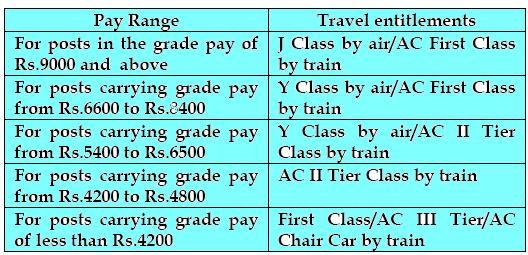
(iii) For travel on tour and transfer the following scale of admissibility have been recommended:


For travel outside the country the travel entitlements would remain the same. However the Commission has recommended that the benefits of mileage points earned by the government servants on official tours would be transferred to the respective departments (for utilisation for official tour of other employees). Utilization of these mileage points by the respective government servant for private journeys would invite disciplinary action.


For travel by road by means of public transport reimbursement to the extent of entitled class train fare is recommended.


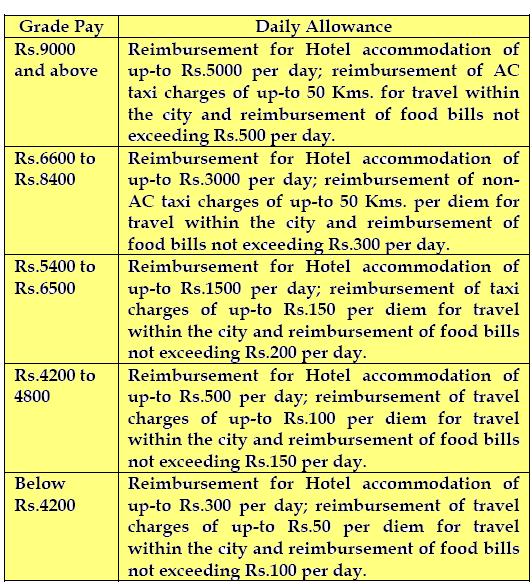
(iv) The Commission has noted that the present rates for reimbursement of daily allowances for officials on tours are grossly inadequate. The recommendations are as follows


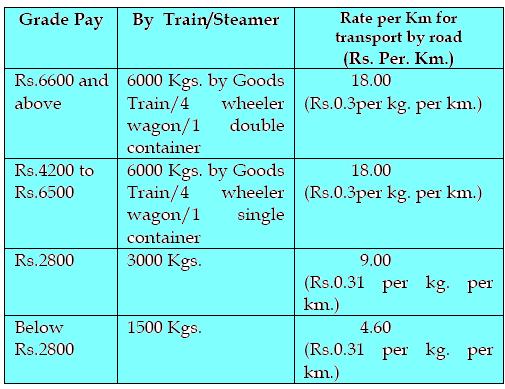
(v)The findings are similar for composite transfer grant payable to employees on transfer involving change of residence in public interest. It has been noted that some of the rates presently adopted are illogical and cause financial hardship to employees. The following rates have been recommended in order to rationalize the structure.


For employees serving in Andaman & Nicobar Islands any further concessions are not found admissible.


The Commission has made the rates for both the above cases dynamic i.e. the rates would increase by 25% whenever the the DA payable on revised pay increases by 50%.It has also suggested that in future the budget for travels should be kept to minimum and unnecessary travels should be avoided.


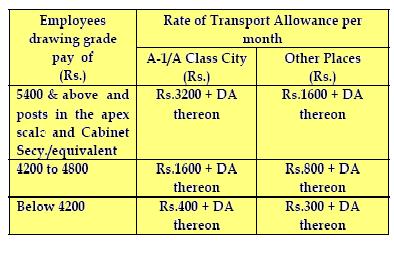
(vi) In respect of Transport Allowance the following revised rates are recommended to compensate for the increase in fuel cost.


The employees staying in official accommodation within proximity of workplace would also be entitled for this allowance. For the physically challenged employees the rates remain double of the rates subject to minimum of Rs.1000/- pm. The Officers in PB=4 have the choice to avail Transport Allowance @ Rs.7000/- pm on condition of giving up the facility of using official transport for traveling between home and workplace .


(vi) The  Non Practicing Allowance (NPA) presently paid to Doctors in  Govt. Service to compensate for loss of private practice has been recommended to be continued for historical reasons and also for the reason that the entry into govt. service is at a relatively late stage for medical professionals and also due to the reason that the working conditions are comparatively difficult. NPA shall be paid @ 25% of sum total of band pay +grade pay subject to ceiling 85000/- on this amount (BP+GP). NPA has not been found admissible for any other category of government employees.


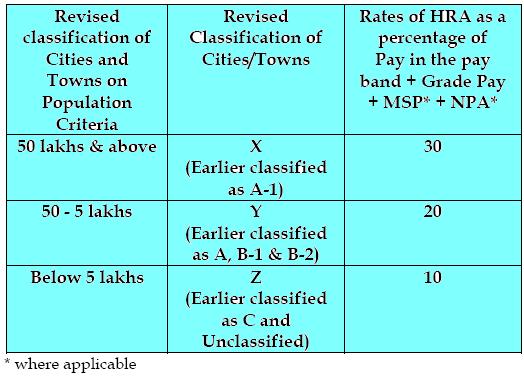
(vii) For considering the demands for increase in House Rent Allowance (HRA) the Commission has taken note of increase in rental values in smaller unclassified towns and attempted to mitigate  sufferings of employees  on this account by clubbing unclassified towns  with Gr. C towns. The rates of HRA recommended are as below.


(viii) Commission has recommended for merger of Children education allowance with Tuition fees reimbursement. Henceforth reimbursement is permissible up-to Rs.1000/- for education and upto Rs.3000/- pm for hostel charges   per child subject to ceiling of two children.


(ix) For employees in hazardous posts involving health risks ,the risk allowance has been discontinued and the employees are now proposed to be covered by free medical insurance ranging from Rs. 5 Lakhs to 10 Lakhs depending on respective category at govt cost .The insurance cover is proposed to be dynamic subject to 50% increase whenever DA increses by 50%.


(x) For Uniformed forces the revised rates of initial grant for uniform allowance shall be Rs.14000/- (Rs.16000/- for coast guards) against earlier rate of Rs.6500/-.Renewal is recommended every three years (instead of earlier 5 years)  @ Rs.3000/- (Rs.5000/- for coast guards) .The rates of kit maintenance allowane for all other categories are also proposed to be doubled.


(xi) For all other allowance such as cycle, washing, cash handling, machine, Night duty, Split duty Allowances the rates are recommended to  be doubled and shall be dynamic being linked to increase in DA as for other allowances mentioned at sl.no.(v) above.


(xii) The rates of Deputation (Duty) Allowance and Central (Deputation On Tenure) Allowance shall continue to be paid @ 5,10 & 15 % of the aggregate of pay and grade pay without any limits . However aggregate of grade pay and Deputation allowance should not exceed Rs.39,2000/- which is the starting pay for PB-4. The Central (Deputation On Tenure) will continue to be  be payable only up-to Director level posts.


Next Post: Retirement benefits


Tuesday, 8 April 2008

Sixth CPC Report (x):Central Services:(ii)

The previous post had covered the recommendations for Central Services Gr. A with reference to common issues for various Central Services. Summary of recommendations for individual services is given below.  


For the Indian Foreign Service the recommendation is for maintaining parity with IAS. The demand of Indian Audit & Accounts Services (IAAS) for merger of posts of Addl Dy CAG and Dy CAG has not been accepted since the same may amount to cadre review -an exercise which Commission does not consider within scope of it's activities. Commission feels that the  Govt. can later consider such requests separately. Commission has also recommended for setting up of a committee for merger of other Gr. A Accounts Services with IAAS with the objective of better resource  utilization . Railway Accounts Service is however to be considered separately in light of recommendation for Corporatisation of Indian Railways .


Indian Civil Accounts Services had demanded the integration of finance and accounts functions . The demand has been considered to be fit for referral to Administrative Reforms Commission.


For Indian Customs & Central Excise Service the demand for restructuring of Central Board for Excise & Customs (CBEC) on pattern of Railway Board has not been accepted since the nature of responsibilities in the two services are different. The demand for encaderment of posts of Chairperson and members of CBEC has also not been found acceptable since this would reduce the flexibility and openness of selection process. The post of Chairman is proposed to be covered in the Scale of Rs.80000 (fixed ) with rank of Special Secretary.


While the demands of Indian Defence Accounts Service have  been found fit for examination by the Govt. separately taking in view the functional needs,  the demand of Indian  Defence Estate Service for creation of three posts in Scale of Rs 24500 -26000 has not been agreed to. Similarly the demand of Indian Economic Service (IES) for time bound promotion up to Higher Administrative Grade (HAG) and similar demands from Indian Statistical Service and Indian Trade Service are expected to be settled with the introduction of the Pay bands providing for uninterrupted mobility in career progression . The scheme of modified ACPs is also expected to take care of similar concerns expressed by these services . The observations with reference to demands of Indian Information Service are of similar nature.


With reference to Indian Ordnance Factories Service recommendations to the Govt. are for studying the feasibility of corporatisation  on the lines of BSNL as recommended by Nair Committee and Kelkar Committee earlier.  It is expected that such a move would make the units financially competitive and viable entities.


Major benefits have been recommended for Indian Postal Service keeping in view the expected expansion of activities in future . Proposals include merger of two pre revised scales of Rs 22400-26000 and Rs. 24050-26000, a step which would place the posts of Pr. Chief Post Master General (Pr.CPMG)  and Member Postal Board in the same pay band (PB-4) and grade pay of Rs.13000/-The Postal service Board is proposed to have six posts of members in the above scale and shall also include post of Pr. CPMG. Commission has recommended that three circles of Maharshtra , Tamil Nadu and MP shall be headed by CPMG  instead of Principal CPMG.


Indian Revenue Service having cadre strength of more than 4400 officers has received specific attention . Commission has noted that  it does not have a single Secretary Level post despite the large cadre strength. The recommendations propose up-gradation of post of member Central Board of Direct Taxes (CBDT) in the scale of Rs.80000/- (fixed) which will be at par with the Scale of Chairman (CBDT) and equivalent to Special Secretary to Govt. of India .The Commission has also proposed encaderment of some posts of Board members in the Indian Revenue Service as a promotional incentive for the service.


Next Post: Recommendations for other allowances 


Monday, 7 April 2008

Sixth CPC Report (ix): Central Services Gr A:(i)

Central Group A Services comprise of Organized and General Group A Services. The Organized Services cover Technical, Non Technical, Medical and other Services including Scientific Services. Taking an overview of the organisational structures the Commission has taken note of the fact that the pyramidical structure of the hierarchy in these services restricts the pace of upward mobility at the top stages leading to stagnation at Higher and Senior Administrative Grades (SAG/HAG) despite of several instances of cadre review and restructuring and consequential induction of several senior level posts in these organizations.


An important recommendation for taking care of this difficulty is for decadring of 20% of the posts in SAG and above ranks by all recognized services which would be allowed be filled up by Govt from any source . The Services would in turn be allowed to operate equal number of non functional posts in Senior or Higher Administrative Grades  to be filled up with officers with minimum length of service as per the laid down procedure. Benefit for promotion to HAG shall be available from 1st January of the year when promotion became due irrespective of the date of DPC. On regular posts being available the officer could be inducted there in without any further procedural delays.


The major demands from Central Services before the Sixth CPC related to parity with IAS, better entry grades scales  and  allocation of posts under Central Staffing Pattern in fair proportion and through a transparent process. Against this demand the Commission has recommended restriction of gap in batchwise parity in Central appointments to the extent of 2 years only. In practical terms this implies that on posting of an IAS officer of a particular batch to a particular grade pay in pay bands PB-3 or 4  in Center, non functional pay scale of higher nature  should be made available to Central Services officers with seniority higher by two years or more as personal scale. The officers would however get substantive postings when vacancies are available. Also for promotion to SAG common policy is recommended to be followed by all the Central Services in order to remove disparities. In order to ensure fair play in process of selection for SAG posts the involvement of UPSC has been recommended. Above measures are expected to remove the  anomalies in career advancement prospects in these Services.


Responding to the demand for higher pay package at the entry grade the Commission has increased the same uniformly for all the Central Services on pattern of All India Services. It has however not agreed to cadre review or restructuring for any service. These are the common issues. Individual service specific recommendations covered  in the next post.


Sunday, 6 April 2008

Sixth CPC Report (viii):Army :Retirement Benefits

For the Armed Forces the Sixth Pay Central Commission (CPC) has offered a liberal package of post retirement benefits. While only a few demands have not been found reasonable on the ground that the benefits sought would automatically flow in the revised pay structure, a number of modifications have been made in favour of the personnel to make the package attractive. Commission has not agreed to the demand for one rank one pay and suggested that the scheme approved by Fifth CPC may continue with two categories of pensioners i.e. pre and post 1/1/86 pensioners who have full parity and pre and post 1/1/96 pensioners who have a partial parity in pension structure.


Under the existing system the Commissioned Officers in the Army are entitled for pension on completing 20 years of qualifying service which at a rate which is 50% of the average of last 10 months' emoluments subject to the condition that full pension is payable on completion of 33 yrs of service. There was also a special benefit of weightage of 3-9 yrs (5yrs for civilians) if the qualifying service was less than 20 years in order to make up for truncated service which is a common feature due to causalities inflicted during action. Recommendation of the Sixth CPC is for removing the condition of 33 years of service for qualifying for full pension. Pension would be calculated on last pay drawn or average emoluments whichever is higher. Military Service Pay would also be counted for calculation of Pension . This gesture would also take care of other demands including that of fixing the pension at highest stage of scale of pay attached to post.


Upper limit for commutation of pension all categories would be 50% and pensioners would be entitled for restoration of commuted value after 15 years.


For second pension the demand for reducing qualifying service (from 15 to 10 years) in respect of ex servicemen employed in Defence Service Corps has not been found justified since Defence Personnel with easier integration into Central Paramilitary Forces (CPMFs) have a longer work tenure nowadays and need for such benefits is not felt.


The benefits given to officers would also be extended to Personnel Below Officer’s Ranks (PBORs). For PBORs revised benefits would be admissible from 1/1/2006. Classification pay would also be taken into account for pension purposes. For PBORs the limit for qualifying service in respect of pensions shall continue as 15 years .The Report suggests that the increase in pension for Group X is expected to be between Rs 2016/- to Rs. 4245 /- and for Group Y pension is to expected increase can be from Rs.1247/- to 3392/-


While considering the demands for increase of pensionary benefits to Havaldars getting Honorary ranks of Naik Subedar it is proposed to consider it as regular promotion to higher grade and give all consequential financial benefit for calculation of pension.


The family pension is also recommended for cases of casualty during trial of weapons and ammunitions. For family pensioners other major changes proposed relate to permitting lifelong admissibility to unmarried daughters (instead of existing provision of pension up to 25 years of age) and also the recommendation that family pension at enhanced rates should be payable up to 10 years (instead of existing limit of 7 years) for personnel dying in harness .


For the case of army personnel who are liable for disability pension or war injury pension the proposals tends to make substantial changes in the quantum of compensation. The rate of disability pension is proposed @ 30% of the basic pay and would be doubled to (60%) if the injury is acquired in a war or war like situation. Commission has also suggested removal of conditions of qualifying service now applicable for retirement cases where disability is not related to service matters. The disability component of pension in all “ attributable” cases ( cases of disability due to service related matters) is also recommended for cases where disability is less than 20%.


Ex servicemen having acquired 100% disability are given constant attendance allowance for engaging attendants throughout their lifetime. Commission has proposed that this may be increased to Rs.3000/- per month instead of existing Rs.600/-.This is a dynamic pay package subject to increase @ 25% whenever the DA payable on revised scales goes up by 50%.


Last major recommendation concerns increase in the rates of exgratia payable to to families of armed forces personnel who die in harness. Recommendations propose doubling of rates for all eventualities. For death in course of duty the quantum proposed is Rs. 10 Lakhs (existing Rs. 5 Lakhs).For causalities in enemy action and international war the amounts proposed are Rs.15 /20 Lakhs ( against existing Rs.7.5/10 Lakhs).


Next Post: Central Services

Friday, 4 April 2008

Sixth CPC Report:(vii) Army Pay Scales (1)

Chapter 2.3 of the Report briefly recaptures the historical developments in reference to determination of pay structure for the Armed Forces, starting from constitution of the Post War Pay Committee in 1947   which for the first time attempted to establish relative parameters in reference to Indian Police Service (IPS) and the Central Class I Services but also brought down the pay scales of many Indian Commissioned Officers. The Government subsequently modified pay structure for Armed Forces in 1960 when the Raghuramaiya Committe endorssed the concept of parity with the above referred  services as conceived earlier.


The pay structure for Army was for the first time referred to Central Pay Commission (CPC) at the time of Third CPC which recommended merger  of the Special Disturbance Allowance (being paid to army personnel since 1950 as a  temporary compensatory measure) with the pay, there by making the pay structure for Army slightly better than civilian pay scales. The Fourth CPC accepted the demand for running pay bands and rank pay up to the scale of Brigadier, but the structure was subsequently realtered by Fifth CPC which gave scales on pattern of civilian establishment to the Armed Forces with a slight edge due to difficult working conditions. The recommendations of Fifth CPC which form the basis for existing pay structure are reflected below.


army-scales-vth-cpc.jpg

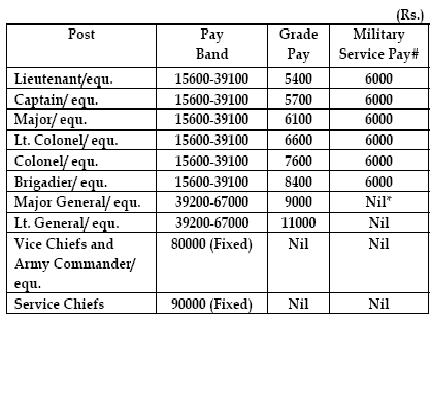
The Sixth CPC has recmmended restoration of Running Pay Bands on the ground that similar structure is now recommended for Civil Services and the possibility of disparity on that account is ruled out .Another important benefit is that  this measure would facilitate smoother  absorption of ths Short Service Commission Officers (SSCOs) and Personnel below Officer' Ranks (PBORs) in Central Paramilitary Forces (CPMFs) by identification of analogous posts in the two structures (e.g.Major and Deputy Commandant in Army and CRPF). It has however added a new component to the salary of armymen under the title of  Military Service Pay(MSP)  which would be admissible to all ranks upto Brigadier.


The Commission foresees that the MSP shall ensure that the edge enjoyed by the army pay structure vis a vis the pay scales for civillian employees continues . MSP shall be counted as pay for all practical purposes. Although MSP shall not be admissible beyond the rank of Brigadier yet the edge provided by MSP shall continue at subsequent stages since it would be embedded in the pay at subsequent fitment stage. However for purposes of determination of comparative seniority the indicator shall be the grade pay. MSP being a new addition to pay, arrears would not be payable for the past. The Pay Structure as recommended by Sixth CPC is as follows.army-pay-scales-vith-cpc.jpg


Some other major recommendations relate to upgradtion of Scale of pay admissible to Director General of Armed Forces Medical Service to Rs.80000/-(fixed) and the decision to allow the non functional scale of Army Commander to Lt. Generals who do not get the post due to age bar. Similar benefit has been recommended for ofiicers of other ranks who are similarily deprived of promotion due to shortage of tenure. Commsision has however not agreed to increase the scales for Principal Staff Officers posted at Army HQs on the ground that this would affect the relativity with Corps Commanders operating in the field.


Commission has also recommended continuation of existing higher entry grade pay to Lieutant in Army Medical Corps (AMC) as compared to Lieutant in the Army. Higher pay to the extent of 7.5% for Lieutant and 10% for the Captain has been recommened. Regarding Military Nursing Services (MNS) the recommendation is for maintainig parity with the Service cadre Officers. Extension of time bound promotion scheme upto level of Lt. Col. has been recommended for the Officers of MNS and MSP to the extent of Rs.4200/- has also been recommended alongwith benefit of one pay fixation increment at the stage of promotion .The Pay Scales recommended for MNS are given below.mns-scales.jpg


Wednesday, 2 April 2008

Report of Sixth CPC :Influenced by Bachchan family?

Since the initial euphoria about the Pay Commission Report was dying out we thought of having a virtual survey of stake holders in order to find out as to who was saying what about the Commission report. While doing rounds of the corridors of power the glowfriend started with the humble Gungadeen peon in Ministry of Sensational Developments . Offcourse Gungadeen had heard the Babus deliberating over the report but all that he knows about his fate is that he would be getting a five figure salary in not too distant future. About the arrears part he was a bit depressed since "..20-25 hajar rupai may to pahli beti ki shaadi wala loan bhi nahi cover hoga...." (20-25 thousand would not even settle the loan for first daughter's marriage) .


The ever cheerful  stenographer in the section Madam Ragini was also not so pleased with the belated announcement on six month's maternity leave " ..... jab bacche bade ho gai.." ( ...now when Children have grown up) and for flexible working hours ."....Yeh bhi kaun si nai baat hai , ladies and officers to sab pahle hi apni marji se aatey jatey the." (What is new about that , ladies and officers came and went as per their will earlier also). Under Secretary Mr. Bhattacharya popularly known as Bhatta Babu was still pouring over the excel sheet hosted by some enterprising "Arrear Calculator" on the website ."..... Yeh saab baaahut conphuson hai DA ka rate ka bare mein kuch theeek theek bola nahin , Khali JS and above ke liye report hai. Hamara kya banega lakh taka bhi nahin milega arrear mein. " (it is all very confusing, DA calculation formula is not clear . All benefit is for JS and above).


We then knoked at the door of PA to JS in the MInistry. PA was a bit scared " Jab se report aaya hai sahab bad mood mein hai ." (Sahab is in bad mood ever since the report has come). Still then glowfriend tried to take a chance. Mr.  Balasain was staring agitatedly at the laptop screen while browsing the download of CPC Report. It's atrocious he said "See we sit here till 9 PM and type out cabinet notes , and it is the peon who corners all the benefit. When I started my job 30 years back a four figure salary was a status symbol . Now my peon will be getting five figure salary. I am shocked! " . When asked about the arrear part Bala was still more upset ."Arrear of 3-4 Lakhs what would that get us ? A single room tenement in some JJ Colony ! And tell me how is the Government concerned with the mileage points that I earn on official journeys by air . How can the mileage points be monitored ?" . Having seen the mood of civil servants we decided to talk to some political bigwigs.


The Old comrade in CPI appeared quite agitated over the manner in which Tatas and Ambanis were taking over the country. "What will the middle class do with that illgotten money ? Buy Nano and what else?  See how the lowest paid workers are suffering everywhere . Is anyone bothered?"


The madam ex politician cum animal right activist  was quirte hurt when asked to comment on the headline "Peanuts for Monkeys" with reference to CPC Report. "Please spare the monkeys why do you degrade them like this" . The politician from South in sunglasses had however a different reaction to the cited headlines."Monkeys are free to enjoy their peanuts but they should not make false claims regarding ancient underwater bridges."


The politico from Bihar was also quite upset like all others " Hum jo kuch bhi karta hai yeh log sab satyanash kar deta hai. Dekho hum rail ka kiraya itna kum kar diye ki ab hamar samadhi log bhi AC two tier mein ticket kharid ke chalta hai. Aur yeh log LTC may hawai jahaj permit karta hai . Sara chhota mota aadmi flight mein bhara rahta hai."(Whatever I do these fellows spoil that. See I have reduced the train fare so much that even my relatives buy tickets for train travel. And these fellows are permitting air travel for LTC . All petty persons nowadays crowd the flights)


For the patriotic reigonal leader the Commission conspiracy is quite evident from the name of Commission itself. "Just see how they have doubled transport allowance . Who do you think will benefit... All Bihari Taxiwalas only. House rent.... they pay highest for Mumbai so that all Govt Servants from whole of the country may rush to this city."

The best response was from the lady CM : "It is all conspiracy of Bachchans to ruin the economy of my State . Very soon our employees would ask for similar pay rise." But how did she conclude that it was inspired by Bachchan influence? " Because dekho yeh Abhishake Bachchan suggested in an ad that all individuals should have a number instead of name for identification. I hear that this Commission has done the same and officer's seniority would now be known with a number. Yeh grade pay kya hai yahi to hai. Sub afsaron ko number de diya." (What is this grade pay, they allotted numbers to all officers). Madam it appeared was agitated since all the fun in suspending and shunting senior bureaucrats had gone. A news item in future would perhaps read like " CM today during her field visit to Rai Bareilly ordered suspension of A Kumar an officer of Grade pay 6000/- while she shunted out B Prasad of Grade Pay 66oo/-...... and with this order the cumulative grade pay total of the officers suspended in the first quarter of the financial year crossed the magical  figure of Rs. 1 Lakh". Public would need a ready reckoner to appreciate the boldness of the job done by Bahanji!.

Sunday, 30 March 2008

Sixth CPC Report:(iv) Pvt. Vs. Govt. Sector

There have been varied responses from the Government employees to the Report of the Sixth Central Pay Commission. There are very few reactions which express satisfaction. Majority of the employees all over the country seem to be unhappy with the recommendations and have termed the recommendations as insensitive and insufficient to their needs. The frustration seems to stem from the fact that the expectation of getting salaries “at par with the private sector “ have not been met as per their interpretation of the Report. What has been overlooked is that the Commission has made sincere efforts to meet this expectation. It has tried to balance the demand with the mandate given to it for transforming the Government workforce into a modern and efficient organization.  


The Commission Report says that it has attempted an in-depth study into working of the private sector and noted that the compensation structure in the private sector is quite different as compared to Government sector. Since the establishments in private sector primarily work for commercial purposes the employee‘s cost is compared to the business worth. Such comparison is not feasible in Government jobs obviously for the reason that the Government sector is primarily service oriented. Also the variation in range of salaries in private sector  is quite wide .


On comparison with Government sector it noted that the salaries can be said to be definitely better in private sector only in reference to jobs which can be compared to Group A services . However in that respect the prestige and challenge offered by the Government jobs is also quite high and the Government jobs also provide incentives by way of compensatory allowances, housing and transport facilities etc.. The biggest advantage offered by a Government job is the job security attached to it and the assured retirement benefits. Commission has attempted to make the retirement benefits more attractive.  It has thus attempted to harmonize the tangible and intangible benefits offered by the two sectors for achieving some element of parity. 


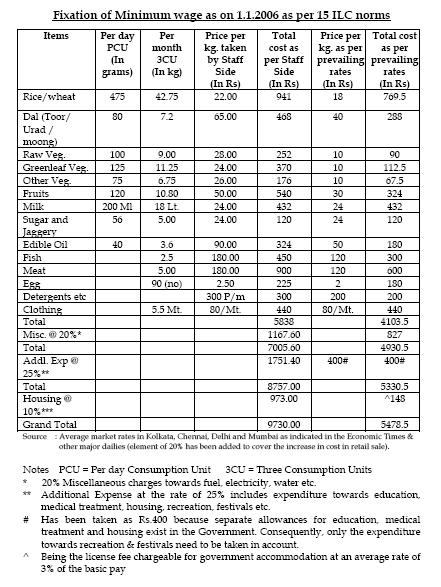
For tackling the demand of the Government employees for making the minimum salary in the range of Rs. 10000/- per month the Commission has followed a multi pronged approach. Firstly it worked out the minimum monthly requirements for the family of lowest paid employee It has based it’s calculations keeping in view recommendations of the 15th International Labour Conference . The expenses when calculated on a family size of three units which is the expected family size for a job entrant came out in range of Rs.5500/-per month.   

minimum-expenses.jpg


          (Source: table 2.2.1 Pg.53 Chapter 2 of Sixth CPC Report)


Thereafter the pay scales were fine tuned to make the minimum salary in the range of Rs. 6600/- in order to make the same approximate to the minimum needs of the lowest paid employees. Commission feels that the addition of HRA and other allowances would make it some where in range of Rs.10000/- as was demanded.  


However simultaneously it also had to ensure that the relief is not considered as a windfall gain for the employees. It has therefore suggested transformation of the lowest paid employees into multiskilled workers whose skill levels could justify the higher wages. The Commission has therefore recommended that the Group D employees be converted to Group C employees in those cases where they fulfill the qualifications prescribed for Group C posts.


This would ensure that they not only get higher wages but also handle higher responsibilities. The employees who do not possess the minimum qualifications should be trained for skill up gradation and subsequent transition to Group C posts. Recruitment to Group C posts is proposed to be stopped forthwith. 


Next post: Estimation of benefits in real terms

Friday, 28 March 2008

Sixth CPC Report: (iii) Concepts of Pay Band, Grade Pay , Performance Linked Incetives

The Sixth Pay Commission has brought about certain significant changes in the pay fixation methodology. The newly introduced concepts are (i) Running Pay Bands (ii) Grade Pay (iii) Performance linked incentives.  The concept of running pay bands although familiar to Armed Forces is proposed for the first time in respect of civilian employees. Running Pay bands were earlier recommended for Armed forces by Fourth CPC but were again replaced with regular scales by Fifth CPC. The Commission has attempted simplification of pay structure by reducing the number of pay grades to 20 against the prevailing 39 scales.


These reduced numer of pay scales (now referred as grades) have been clubbed together to form several distinct pay bands named as -1S,PB-1,2,3,4.    Pay band -1S (Rs. 4400/--7400/-) corresponds to Group D scales marked as S-1 to S-3 by the Fifth CPC . The Commission has recommended gradual absorption of such employees in Group C posts and also recommended that no further recruitments be made in this scale of pay. The Scale would thus be phased out with passage of time. It has 3 grade pays in it’s span. 


The next Pay Band PB-1 (Rs.4860/- -20200/-) covers the Group C Scales which were classified  by fifth CPC as S-4 to S-8. PB-1 has 5 distinct pay grades within it. 


 PB-2 (Rs.8700/--34800/-) covers the Gr. B employees ( S-9 to S-15 Scales of Fifth CPC).  It includes 4  pay grades within it.


table1.jpg


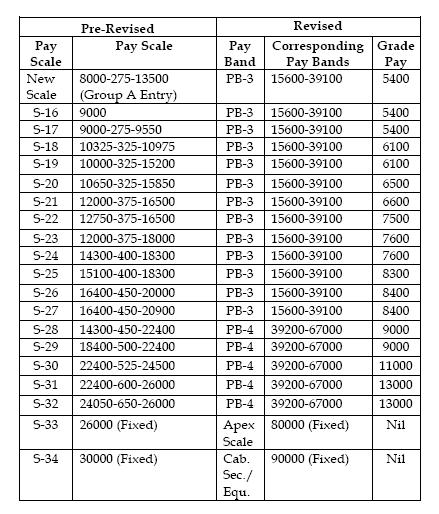
 PB-3 (15600/--391000/-) is the Pay Band corresponding to Group A services and has  a total span of 32 years. The old scales covered by the Band are S-16 to S-27. It has total of 8 grades embedded in it’s span. 


PB-4 (Rs.39200/--67000/) corresponding to Super time Scale covers S-28 to S-32 Scales of Fifth CPC and has 3 distinct grade pays corresponding to various stages of movement of the employee. 


table-2.jpg


Apex Scale (Rs.80000/-) corresponds to erstwhile scale of S-33 which is the pay Scale designated for officers of the rank of Secretary Govt. of India. The Cabinet Secretary’s Scale (Rs. 90000/-) corresponds to S-34 Scale of Fifth CPC. 


The Commission expects that the concept would lead to elimination of hierarchies and weed out several pay scales which had lost relevance. The concept of a continuous pay band would obviate anomalies which are generated at the various stages of pay fixation . It would also prevent stagnation in those cases where an employee has reached the maximum of his pay scale. It has been pointed out that when the recommendations of the Fifth CPC were implemented several employees reached the maxima of respective pay scales immeadiately. such a situation is required to be averted. In the proposed system any officer reaching maximum of Pay Band would be automatically rolled over to next Pay Band subject to the condition that the original grade pay would not change unless the official is formally promoted to higher Pay Band.   The Commission has tried to maintain the increase in scales to the approximation of 74% which is the % increase of DA which was admissible on 1/1/06 in the pay scales of Fifth CPC. 


Concept of Grade Pay:-In order provide fitment benefits in the new pay scales and also to provide for a hierarchy based structure for the various Pay bands the Commission has introduced the concept of grade pay. The grade pay for various stages have been fixed on basis of the span of original pay scale covered as well as the nature of the Fifth CPC  pay scale of the beneficiary. The grade pay has been fixed in the range of 40% of the maximum of the pre revised scales (of Fifth CPC). It would change in course of time when a promotion takes place within the pay band or to the next pay band. It would also help in earmarking posts against different grades depending on the job requirement. The Grade Pay would also be taken as part of the pay for calculation of allowances including DA. 


Performance linked Incentive Scheme have been conceived for PB-3 which covers the group A Services . The scheme suggests a higher rate of increment (3.5%) for good performers against standard rate of 2.5% per annum. It has been suggested that not more than 20% officers in a cadre should be covered with the higher increment category. The Commission considers this to be an innovative measure for promoting efficiency in Services. 


Other innovations : The Commission has maintained a ratio of 1:12 in the minimum to maximum salary. It has also suggested that henceforth all increments be released on 1st of July. 

Wednesday, 26 March 2008

Sixth CPC Report :(i) Dearness Allowance

The Sixth Central Pay Commission (CPC) has devoted fourth chapter of the report to the subject of Dearness Allowance (DA) payable to government servants. The sanction of Dearness Allowance is at present based on calculated six monthly increase in the All India Consumer Price Index (Industrial Workers) (AICPI-IW) with base year 1982=100. At the time when the scales granted by Fifth CPC came into existence (1st Jan.1996) this index stood at 306.03.


Fifth CPC started with calculation of DA @ 0% . from 1st Jan.1996 . In the month of April 2004 the rate at which DA was admissible had crossed the figure of 50% and therefore based on recommendations of the Fifth CPC 50% DA was merged in the basic pay . This addition to basic pay was known as Dearness Pay. .Thereafter every increase in DA was calculated on (Basic Pay + Dearness Pay). It has been observed that since after the merger of dearness pay with basic pay the base for calculation of increase in AICPI was not changed the neutralization in cost of living was presently being done at a rate higher than 100%.


Commission has pointed out that the present method of calculation for increase in cost of living takes into account the price rise in a group of identified commodities. It has compared the relative merits of “chain based” and “fixed base” methods of calculation of estimated growth in cost of living. The AICPI as stated above is based on the increase in cost of a basket of identified commodities. In the fixed base method the calculations are based on the assumption that consumer would adjust his consumption needs in relation to increase or decrease in prices of the constituent commodities. The chain based method takes into account the possibilities of change in consumption pattern due to availability of wider range of consumption goods and the improvement in the quality thereof due to economic growth. The latter methodology has been considered to be more relevant in today’s economic scenario.


However the basic data for the pattern of consumption in respect of several essential commodities would have to be compiled through a detailed all India survey if this methodology is to be adopted . The previous Pay Commissions had different views on this matter. The Fourth CPC favored evolution of a separate index for calculation of cost of living for the government servants. The Fifth CPC however felt that such index would also suffer from imbalances since consumption patterns of various categories of employees would be different. The Sixth CPC has suggested a sample survey through National Statistical Commission for evolving an index based on consumption pattern of government employees. Till this exercise is completed the present methodology of calculating the increase in cost of living and calculation of DA would continue.


Monday, 24 March 2008

Report of Sixth Pay Commission:who gets what

The Sixth Central Pay Commission (CPC) Report was out in the afternoon and simultaneously the work force in sarkari establishments went into jubilation. Calculators were brought out and the humble pay clerk in the office became the most sought after person to facilitate estimation of how much bucks would flow in whose kitty. Euphoria of this kind is a regular occurrence after announcement of pay benefits but is short-lived till the actual calculations are made. The rapid rise in market prices and also the amazing growth of salaries in private sector soon overtake the government pay scales.  


On this  occasion the media is all agog with the overestimated projections of benefits and for days together it goes on repeating the imagined negative impact on the national economy. The media forgets the fact that journalists also look forward for wage increase and as compared to the increase in every other sector the Government servants get a modest jump in pay every ten years . It is also forgotten that the economic impact on budget which is sought to be over hyped is the  only decadal benefit offered to millions of families of government servants who are also fellow countrymen and have a right to share the national wealth.  


A quick glance at the report and projected pay scales (now referred to as pay bands) shows that on an average a government servant would get additional financial benefits which would be in the range of 40% of the existing basic pay. Even the top salaries of Secretary in Govt. of India and Cabinet Secretary which appear to be quite high in real terms are likely to increase  to that extent only. 


The real indicators of improvements in working conditions as reflected in the report of the Pay Commission  are the measures suggested to take care of female employees, group D employees, physically challenged employees and the pensioners. The Commission has also suggested improvements in the allowance and compensation packages for army men. For healthcare it has proposed Health Insurance Schemes at places where CGHS facilities are not available. 


For the women employees the facility of maternity leave is extended to six months against existing three months and concept of flexible working hours has also been brought in. The suggestions if accepted would certainly be considered as a very progressive gesture on part of a caring employer. 


In respect of the lowest paid employees presently classified as Group D employees the Commission has suggested their upward mobility to Group C in case they fulfill the educational qualifications . Those who do not possess the requisite qualifications are proposed to be trained to rise to Group C in due course of time. The Commission seeks to transform them into multi skilled persons. Attention of this nature  on workforce on the lowest rung of ladder was also  long overdue.  


For the physically challenged employees the concept of flexible working hours has been introduced. The Commission has also proposed measures which would facilitate their access to good quality aids and appliance which would help them overcome the respective disabilities in a better manner. Other benefits which have been proposed are higher rate of transport allowance and subsidy in the loan for purchase of car @ 4%. 


Retiring Govt. employees can now expect a higher quantum of gratuity (an amount equal to 15 Months emoluments at the retirement stage). The ceiling of Rs. 3.5 Lakhs has been proposed to be raised to Rs. 10 Lakhs. Another innovative measure suggested for helping the retired employees is increase in pension at various stages between 80 to 100 years of age. It is proposed to increase the benefit @ 20% for 80 year olds and thereafter @ 20% for each slot of subsequent 5 years. This has been justified on grounds of increased expenses on medical facilities in old age and is a very well thought gesture. 


For improving the morale of army men additional compensation in case of casualty has been proposed. The Commission has also suggested additional pay for those in line of service. 


As a part of system improvement the daily allowance for officers on tour has been made more realistic so that the govt servants on duty can stay in comfort. Officers availing LTC have been permitted air travel if they are entitled for the same for official tours. Leave encashment procedure for LTC has also been liberalized. 


The major indicator of structural reforms made by the Commission is reduction in  the number of pay scales . The Commission has also introduced the concept of pay band by clubbing  a number of scales into a long running scale with grade pay as mark of identification of seniority. The Commission expects to iron out several anomalies by introduction of this concept. Another new concept introduced by Commission is concept of differential increment rate based on performance. Unlike other measures this suggestion may not be met with enthusiasm since performance appraisal in public services is still a grey area which is not yet truly modernized.